 New Zealand
 IndiaNew Zealand
India tour of New Zealand ODI Series, 2026
NZvsIND
ODI · Match 4
Bay Oval, Mount Maunganui
IndiaMatch analysis
Select a section to explore the available match analysis.











| NZ | IND | Winner | Series | Match | Date | Ground | MOTM |
|---|---|---|---|---|---|---|---|
| 0/0 (Balls 0) | 0/0 (Balls 0) | No Result | India tour of New Zealand ODI Series, 2026 | Match 3, ODI | 10-11-2026 | Seddon Park, Hamilton | NA |
| 134/10 (Balls 246) | 113/7 (Balls 156) | IND | India tour of New Zealand ODI Series, 2026 | Match 2, ODI | 07-11-2026 | Sky Stadium, Wellington | Gurnoor Brar |
| 185/10 (Balls 242) | 143/5 (Balls 136) | IND | India tour of New Zealand ODI Series, 2026 | Match 1, ODI | 04-11-2026 | Eden Park, Auckland | Anshul Kamboj |
| 337/8 (Balls 300) | 296/10 (Balls 276) | NZ | New Zealand tour of India ODI Series, 2026 | Match 3, ODI | 18-01-2026 | Holkar Cricket Stadium, Indore | Daryl Mitchell |
| 286/3 (Balls 285) | 284/7 (Balls 300) | NZ | New Zealand tour of India ODI Series, 2026 | Match 2, ODI | 14-01-2026 | Saurashtra Cricket Association Stadium, Rajkot | Daryl Mitchell |
Player statistics
Statistics based on the teams’ last five ODIs since 2020
Average Scores
Wickets
Winning Percentage
Venue records
| First-Inning | Second-Inning | Winner | Series | Match | Date | MOTM |
|---|---|---|---|---|---|---|
| ENG: 223/10 (Balls 212) | NZ: 224/6 (Balls 220) | NZ | England tour of New Zealand ODI Series, 2025 | Match 1, ODI | 26-10-2025 | Harry Brook |
| NZ: 264/8 (Balls 252) | PAK: 221/10 (Balls 240) | NZ | Pakistan tour of New Zealand ODI Series, 2025 | Match 3, ODI | 05-04-2025 | Michael Bracewell |
| NED: 202/10 (Balls 298) | NZ: 204/3 (Balls 231) | NZ | Netherlands tour of New Zealand ODI Series, 2022 | Match 1, ODI | 29-03-2022 | Will Young |
| IND: 296/7 (Balls 300) | NZ: 300/5 (Balls 283) | NZ | India tour of New Zealand ODI Series, 2020 | Match 3, ODI | 11-02-2020 | Henry Nicholls |
Recent Performances
Top Performers
In teams’ last five ODIs









New Zealand vs India Match Preview
Pre-match context and key talking points.
New Zealand and India move to Bay Oval, Mount Maunganui, for the fourth ODI of the India tour of New Zealand series on 13 November 2026, with the contest arriving at an interesting point in the exchange. India have won the first two completed matches of the series, while the third game in Hamilton did not produce a result, leaving New Zealand searching for a response and India looking to extend the control they have established in these conditions.
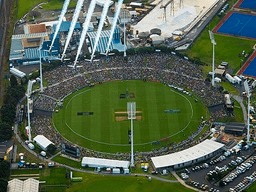
Bay Oval is a venue that tends to keep both batters and bowlers in the game, and that balance gives this fixture added intrigue. The surface is known for true bounce and a quick outfield, but there is also enough evidence to suggest that disciplined bowling, particularly through the seamers early and more controlled methods later on, can shape the direction of an ODI here.
Conditions & Venue
The numbers at Bay Oval point to a ground where chasing sides have enjoyed the better of things. Across the last four ODIs here since 2020, the average first-innings score is 246 and the average second-innings score is 237, but teams batting second have won three of those four matches. That suggests the totals have generally remained within range rather than spiralling away from the side chasing.
There is also a clear seam-bowling tilt in the wicket distribution. Fast bowlers have claimed 46 wickets compared to 11 for slow bowlers in the sample available. That does not entirely rule out spin as an influence, especially on a surface that can offer some grip as an innings develops, but it does underline how important new-ball control and hard-length pace bowling can be at this venue.
Two matches offer a useful snapshot of the ground’s range. In 2020, New Zealand chased down India’s 296 with five wickets in hand, showing that substantial first-innings scores can still be vulnerable here if batting conditions hold. By contrast, in 2025, England’s 223 was not enough as New Zealand completed another chase, reinforcing the sense that Bay Oval has often allowed the side batting second to stay in the game.
The venue profile overall is that of a batting-friendly ground without being one-dimensional. Teams that use the early pace in the surface well can score fluently, but with seamers taking the bulk of wickets here, accuracy and discipline remain just as important as strokeplay.
Team Form & Head-to-Head
New Zealand’s recent ODI run has been mixed, and their immediate concern is the batting output in this series. They were bowled out for 185 in Auckland on 4 November 2026 and then for 134 in Wellington on 7 November 2026, with India winning both games. Before this series, New Zealand had split their last two completed ODIs against West Indies in July 2026, including a narrow chase of 189 and a defeat after posting 268. The broader pattern is of a side that has remained competitive with the ball but has not put enough scoreboard pressure on opponents often enough in the current series.
India come into this match with stronger momentum. They have won three of their last five ODIs, including both completed games in this series, and their form sheet also includes a remarkable chase of 406 against West Indies in Guwahati on 30 September 2026. Even their defeat in Mullanpur three days later came in a game where 351 proved insufficient, so India’s recent matches have shown both batting range and the ability to adapt to lower-scoring contests in New Zealand.
The head-to-head picture from the last five ODIs between these sides since 2020 is finely balanced in a longer view but tilted toward India in this series. New Zealand won twice in India in January 2026, and those victories were built on substantial batting returns, including totals of 286 and 337. India, though, have responded by taking the first two completed matches of this home-away cycle in New Zealand, largely by forcing New Zealand’s batting unit into difficult positions early.
That contrast may be central to this contest. New Zealand have shown in 2026 that they can make big ODI totals against India, but India have so far dictated the terms in New Zealand by reducing the game to totals of 185 and 134. Whether Bay Oval produces a higher-scoring match than Auckland and Wellington could have a major bearing on how the balance shifts.
Players to Watch
For New Zealand, Daryl Mitchell remains the most compelling batting figure. He struck 131 in Rajkot on 14 January 2026 and followed it with 137 in Indore on 18 January 2026 in the earlier ODI meetings between these teams, underlining how effective he can be against this attack when he settles in. In the current series, he has also been one of New Zealand’s few batters to spend time at the crease, making 55 from 104 balls in Wellington on 7 November 2026. If New Zealand are to build the kind of total that tests India properly, Mitchell’s role in the middle overs looks pivotal.
Jacob Duffy has been one of New Zealand’s bright spots with the ball. He has taken three wickets in each of the first two matches of the series, and his record against several India batters is encouraging. He has dismissed Virat Kohli twice while also removing Shubman Gill and Shreyas Iyer in the current body of meetings. On a ground where seamers have dominated the wicket charts, Duffy’s control could again be central.
Kyle Jamieson also stands out as an important factor. His three wickets in Wellington on 7 November 2026 came in a low-scoring match where every breakthrough mattered, and his numbers against India’s top order are significant: he has dismissed Rohit Sharma twice and Shubman Gill twice in the available matchups. At Bay Oval, where bounce and carry can reward hit-the-deck seam bowling, that profile becomes especially relevant.
For India, Virat Kohli remains a major threat. He made 74 from 51 balls in Auckland on 4 November 2026, and his broader record against New Zealand in ODI cricket within the supplied sample includes a century in Indore in January 2026. Even in a series shaped by bowlers, Kohli’s ability to control a chase or accelerate against seamers gives India a dependable axis in the batting order.
Shubman Gill, India’s captain, brings both recent form and authority at the top. His standout ODI effort in the current data set is the 223 against West Indies in Guwahati on 30 September 2026, a reminder of the scale he can reach once set. Against New Zealand, he has also produced useful returns, including fifties in January 2026, and his duel with Jamieson and Duffy could help set the tone of India’s innings.
Among the bowlers, Gurnoor Brar has had a decisive impact on this series. He followed a three-wicket haul in Auckland with 4 for 30 in Wellington, the latter performance earning him the player-of-the-match award. He has already troubled several New Zealand batters, including Tom Latham and Glenn Phillips, and his ability to hit hard lengths makes him particularly interesting at a venue where fast bowlers have overwhelmingly taken the wickets.
Arshdeep Singh is another name to watch closely. His four wickets in the first ODI at Eden Park were crucial to India’s control of that match, and his left-arm angle gives India a slightly different look alongside their right-arm seam options. He has also dismissed Glenn Phillips twice and Will Young once in the available matchups, suggesting he can challenge New Zealand’s top and middle order in different phases.
Final Word
This match appears set to revolve around two connected themes: whether New Zealand can produce a more substantial batting effort, and whether India’s seam attack can continue to dictate the shape of the game. Bay Oval’s history hints at a venue where chasing has often worked well, but it is also one where fast bowlers have had the strongest say. That combination puts a premium on early wickets, middle-overs control and the ability to build a total that does not leave too much room for a composed chase.
India arrive with the stronger recent form and the more convincing returns from the first two completed matches, while New Zealand can draw on both home familiarity and evidence from earlier in 2026 that they are capable of putting India under serious scoreboard pressure. With Bay Oval offering enough for batters and seamers alike, the fourth ODI has the ingredients for a sharp, closely contested game.
Match News
Recent news and updates related to this match.